
Custom Patch Hats: The Complete Guide to Branding Your Business With Style
If you have shopped for headwear for your business, your team, or your brand lately, you have probably noticed one style showing up everywhere: custom patch hats. Walk into a coffee shop, a construction site, a golf course, or a music festival and you will spot them on heads of every kind. There is a reason this trend has stuck around instead of fading like so many other apparel fads. Patch hats work. They look good, they hold up over time, and they give a business a way to show off its logo without looking like a walking billboard.
This guide breaks down everything you need to know about custom patch hats, from the materials used to make them to how they are produced, and how to choose the right supplier so your finished product actually looks the way you pictured it. Whether you run an embroidery shop, manage a promotional products company, or are a small business owner ordering hats for the first time, this article is built to answer the real questions people ask before they place an order.
Table of Contents
- What Are Custom Patch Hats
- Why Businesses Use Custom Patch Hats
- Types of Custom Patch Hats
- How Custom Patch Hats Are Made
- Why Embroidery Digitizing Matters
- Choosing the Right Patch Material
- Choosing the Right Hat Style
- Patch Placement
- Branding Benefits by Use Case
- Pros and Cons of Patch Hats
- Maintenance Tips
- Common Mistakes to Avoid
- Buying Guide
- How to Choose a Custom Patch Supplier
- How Neon Digitizing Helps
- Frequently Asked Questions
- Final Thoughts
What Are Custom Patch Hats
Custom patch hats are caps, usually structured trucker hats or five panel snapbacks, that feature a logo or design applied as a separate patch rather than stitched directly onto the fabric of the hat itself. The patch is made independently, using materials like leather, PVC, embroidery thread, or woven polyester, and then attached to the front panel of the hat using stitching, heat pressing, or a hook and loop backing.
This is different from a hat with direct embroidery, where the needle stitches the design straight into the cap fabric. With patch hats, the design lives on its own piece of material that gets applied afterward. That distinction matters because it changes the texture, durability, and overall look of the final product.
Businesses like patch hats because they offer a premium feel without the premium price tag of fully custom manufacturing. A blank trucker hat with a leather patch can look like a boutique brand item even when it was produced affordably in bulk.
Why Businesses Use Custom Patch Hats
There are a handful of practical reasons patch hats have become a go to choice for branding.
They look established. A well made patch gives off the impression of a brand that has been around, even if the company launched last year. Leather and PVC patches especially carry a rugged, lived in look that resonates with outdoor, workwear, and lifestyle brands.
They are durable. Patches, particularly leather and PVC, hold up to weather, washing, and daily wear far better than flat screen printing.
They are versatile. The same patch design can be produced in leather for one batch of hats and PVC for another, giving a business flexibility without redesigning the artwork each time.
They photograph well. For businesses that rely on social media or product photography, patches add depth and texture that a flat printed logo cannot match.
They support bulk ordering. Once a patch design is finalized, it can be reproduced consistently across hundreds or thousands of units, which matters for corporate uniforms, team gear, and promotional giveaways.
Types of Custom Patch Hats
Not all patches are created equal. Each material brings a different look, price point, and durability profile. Here is a breakdown of the most common patch types used on custom hats today.
Leather Patches
Leather patches, often made from genuine or faux leather, are laser engraved or debossed with a logo. They give hats a rustic, premium appearance and are extremely popular with outdoor brands, breweries, farms, and lifestyle companies. Because the design is engraved rather than printed, it will not fade or peel over time.
PVC Patches
PVC patches are made from a soft, rubber like material that is molded into a 3D shape. They allow for bold colors and raised detail, which makes logos pop visually. PVC holds up extremely well outdoors, resists water, and is a favorite for workwear brands, sports teams, and tactical or outdoor gear companies.
Embroidered Patches
Embroidered patches use thread stitched into a base fabric to recreate a logo. This is the most traditional patch style and gives a classic, textured look. Embroidered patches work well for detailed logos with multiple colors, though very fine text or thin lines can be harder to reproduce cleanly compared to PVC or leather.
Woven Patches
Woven patches are made using a tighter weave of thread than standard embroidery, which allows for much finer detail and smaller text. These are ideal for logos with intricate line work, small lettering, or gradients that would look bulky if embroidered traditionally.
Chenille Patches
Chenille patches use a thicker, fuzzy yarn to create a bold, retro varsity look, similar to what you would see on old school letterman jackets. These patches are larger and more textured, making them a popular choice for collegiate style branding, throwback designs, and streetwear.
Comparison Table: Patch Types at a Glance
| Patch Type | Best For | Durability | Detail Level | Typical Look |
|---|---|---|---|---|
| Leather | Outdoor, lifestyle, rustic brands | Very high | Moderate | Premium, rugged |
| PVC | Workwear, sports, tactical brands | Very high | High with bold color | 3D, vibrant |
| Embroidered | Classic branding, uniforms | High | Moderate | Traditional, textured |
| Woven | Detailed logos, small text | High | Very high | Flat, crisp |
| Chenille | Retro, varsity, streetwear | Moderate | Low to moderate | Bold, fuzzy, vintage |
How Custom Patch Hats Are Made
The process behind a finished patch hat involves more steps than most people expect. Here is the general workflow used across the embroidery and patch making industry.
- Artwork submission. The customer sends a logo, typically as a JPEG, PNG, or PDF.
- Vector conversion. If the logo is not already in vector format, it needs to be converted so it can be scaled cleanly to any size without losing quality.
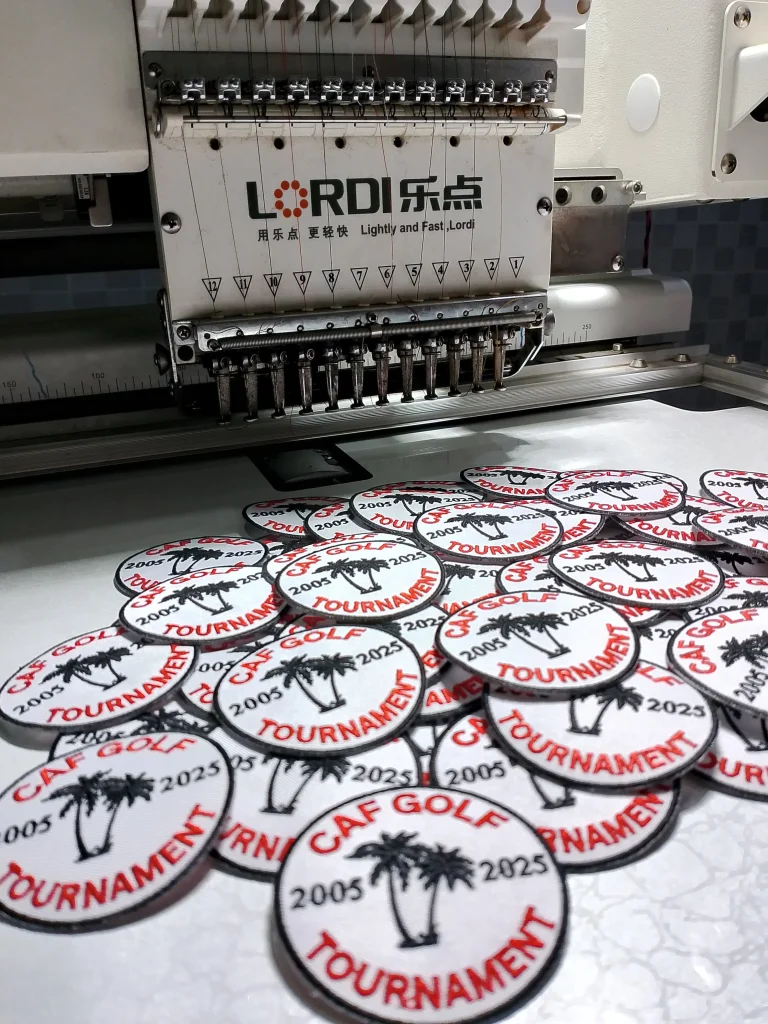
- Digitizing. For embroidered, woven, or chenille patches, the artwork is converted into a stitch file that embroidery machines can read. This step is often the difference between a patch that looks crisp and one that looks muddy or distorted.
- Patch production. Depending on the material, the patch is either stitched on an embroidery machine, laser cut and engraved for leather, or molded for PVC.
- Backing application. Patches are finished with a backing method, usually iron on, sew on, or hook and loop (commonly called Velcro).
- Attachment to hat. The finished patch is stitched or pressed onto the front panel of the hat.
- Quality check. Reputable suppliers inspect stitch quality, alignment, and color accuracy before shipping.
Why Embroidery Digitizing Matters
This step gets overlooked by a lot of first time buyers, but it is one of the most important parts of the entire process. Embroidery digitizing is the process of converting artwork into a stitch file format that embroidery machines like Tajima, Brother, Barudan, Ricoma, or Melco can actually read and execute. These files typically come in formats like DST or PES.
A poorly digitized file can cause a whole list of problems: thread breaks, puckering fabric, gaps in coverage, uneven stitch density, or a logo that simply does not resemble the original artwork. A well digitized file accounts for stitch direction, density, underlay stitching, and the natural pull of thread on fabric, so the finished patch holds its shape and looks sharp at any size.
This is precisely where a service like Neon Digitizing’s embroidery digitizing service becomes valuable. Getting a production ready file the first time saves embroidery shops and businesses from costly reorders, machine downtime, and wasted material.
If your original logo is a flat image file rather than a scalable vector, it typically needs to go through vector art conversion before digitizing. This ensures clean lines, accurate color separation, and a file that scales properly whether it is going on a small hat patch or a large jacket back.
Choosing the Right Patch Material
Picking a patch material is not just a style decision, it is a practical one. Here is how to think through it.
- If your brand has a rugged, outdoor, or premium feel: leather patches are usually the strongest choice.
- If your logo has bold colors and simple shapes: PVC patches will make it pop and hold color well outdoors.
- If your logo has fine detail, small text, or gradients: woven patches will reproduce it more accurately than standard embroidery.
- If you want a traditional, textured look: embroidered patches remain a reliable, classic option.
- If you want a retro or collegiate aesthetic: chenille patches deliver that nostalgic feel instantly.
It also helps to think about where the hats will be worn. Outdoor workwear and uniforms benefit from PVC or leather because of their weather resistance. Retail and lifestyle brands often lean toward leather or woven for a more polished look. Sports teams and spirit wear frequently use chenille or embroidered patches to match traditional team branding.
Choosing the Right Hat Style
The patch is only half the equation. The hat style itself affects how the finished product looks and fits.
Trucker Hats
Trucker hats, with their mesh back panels and structured front, are the most common style paired with patches. The flat front panel gives patches plenty of room and the mesh back keeps the hat breathable.
Five Panel Hats
Five panel hats offer a more minimalist, streetwear inspired silhouette. They work well with smaller or centered patches and are popular with younger, trend focused audiences.
Snapbacks
Snapbacks provide a flatter brim and a more structured fit, giving patches a clean, prominent display area. This style is common for sports teams and streetwear brands.
Structured vs Unstructured
Structured hats hold their shape with a stiffer front panel, which is ideal for larger or more detailed patches. Unstructured hats have a softer, more relaxed look that works better with smaller or simpler patch designs.
Patch Placement
Most patches are placed on the front center panel of the hat, but placement can vary depending on brand goals.
- Front center: the default choice for maximum visibility and brand recognition.
- Side panel: used for secondary logos, taglines, or a more subtle branding approach.
- Back panel: occasionally used for a hidden detail or a secondary design element.
Size matters as much as placement. A patch that is too small can look lost on a larger hat, while one that is too large can overwhelm the front panel and crowd the brim. A general rule of thumb is to keep the patch proportional to the front panel, usually somewhere between two and a half to three inches wide for most trucker and snapback styles.
Branding Benefits by Use Case
Corporate Branding
Custom patch hats give companies a professional yet approachable way to reinforce brand identity at conferences, client meetings, and everyday office wear. A leather or embroidered patch with a clean logo reads as polished without looking like a promotional throwaway item.
Sports Teams
Teams use patch hats for game day gear, fan merchandise, and coaching staff uniforms. Chenille and embroidered patches are especially popular here because they mimic traditional athletic branding.
Events
Festivals, conferences, and pop up events often use patch hats as premium merchandise or VIP giveaways. PVC patches are a strong choice here because of their durability and eye catching color.
Employee Uniforms
Workwear brands and service companies rely on patch hats to create a consistent, professional look across teams. PVC and leather patches resist wear from outdoor conditions, making them ideal for construction, landscaping, and field service industries.
Promotional Giveaways
For trade shows and marketing campaigns, patch hats function as a memorable takeaway item that recipients are actually likely to wear again and again, extending brand exposure well beyond the event itself.
Pros and Cons of Patch Hats
Pros
- Durable and long lasting compared to screen printed hats
- Wide variety of material options to match brand identity
- Premium appearance at a reasonable bulk price point
- Highly photogenic for marketing and social media use
- Consistent quality across large production runs
Cons
- Higher upfront cost than simple screen printed caps
- Requires proper digitizing or vector work for best results
- Turnaround times can be longer due to the extra production steps
- Very intricate logos may need simplification for smaller patches
Maintenance Tips
Patch hats are built to last, but a few care habits will keep them looking sharp for years.
- Spot clean with a damp cloth rather than machine washing whenever possible
- Avoid soaking leather patches, since excess moisture can warp or discolor them
- Keep hats away from direct heat sources like dryers, which can melt PVC patches
- Store hats upright or on a hat rack to preserve the shape of the brim and panel
- Address loose stitching early before it spreads and the patch begins to lift
Common Mistakes to Avoid
- Sending low resolution artwork. A blurry logo file leads to a blurry or inaccurate patch.
- Skipping the digitizing step. Assuming any embroidery machine can just “read” a logo file without proper digitizing is one of the most common and costly mistakes businesses make.
- Choosing the wrong material for the use case. A delicate chenille patch on a hat meant for rugged job site use will not hold up the same way PVC would.
- Ignoring color limitations. Some patch types, particularly embroidery, have practical limits on how many colors and how much fine detail can be reproduced cleanly.
- Underestimating turnaround time. Custom patch production takes longer than simple screen printing, so last minute ordering can lead to disappointment.
Buying Guide
When you are ready to place an order, work through these questions first.
- What is the primary use case? Corporate wear, team gear, retail merchandise, and workwear all favor different materials.
- What does the logo look like? Fine detail favors woven or PVC, bold simple shapes work well in leather or embroidery.
- What is the order quantity? Larger orders may open up better per unit pricing and more customization options.
- What is the timeline? Build in extra time for digitizing, sampling, and production, especially for first time orders.
- Do you have production ready artwork? If not, factor in time for vector conversion and digitizing before the patch production even begins.
How to Choose a Custom Patch Supplier
Not every supplier delivers the same quality, so it helps to know what separates a reliable one from a risky one.
- Ask to see samples of their actual patch work, not just stock photos.
- Confirm they handle digitizing in house or have a trusted digitizing partner, since this step directly affects final quality.
- Check their communication and revision process. A good supplier will review your artwork and flag potential issues before production begins, not after.
- Compare turnaround times honestly, since rushed production often sacrifices quality control.
- Look for a supplier who can explain their process clearly, rather than one who is vague about how patches are actually made.
How Neon Digitizing Helps Businesses Create Production Ready Patch Artwork
Getting a patch hat right starts long before the embroidery machine ever runs. It starts with the file. Neon Digitizing works with embroidery shops, promotional product companies, and businesses ordering their first batch of custom hats to make sure the artwork behind every patch is production ready.
That means clean vector art conversion for logos that were never built to scale, and precise embroidery digitizing for embroidered, woven, and chenille patch styles, formatted correctly for machines like Tajima, Brother, Barudan, Ricoma, and Melco. For businesses exploring different patch styles and want a closer look at real project examples, the patches work portfolio shows finished examples across leather, PVC, embroidered, and woven styles.
If you are planning a custom patch hat order and want the artwork done right the first time, the team is available through the contact page to review your logo and walk through the best approach for your specific project.
Frequently Asked Questions
1. What are custom patch hats? Custom patch hats are caps featuring a separately made patch, such as leather, PVC, embroidered, or woven material, attached to the front panel instead of stitched directly into the hat fabric.
2. What is the difference between embroidered and woven patches? Embroidered patches use standard thread stitching and work well for bold designs, while woven patches use a tighter weave that captures finer detail and small text more accurately.
3. Are leather patch hats durable? Yes, leather patches are engraved rather than printed, so the design does not fade, crack, or peel over normal use.
4. How long do PVC patches last? PVC patches are highly weather resistant and typically hold their color and shape for years, even with regular outdoor use.
5. What file format is needed for embroidery digitizing? Embroidery machines commonly use DST or PES files, which are created during the digitizing process from your original artwork.
6. Can any logo be turned into a patch? Most logos can be adapted, though very intricate designs may need simplification depending on the patch type and size.
7. What is the most popular hat style for patches? Trucker hats are the most common choice because their structured front panel and mesh back pair well with most patch sizes and materials.
8. How much does a custom patch hat typically cost? Pricing varies based on patch material, hat style, and order quantity, with leather and PVC generally costing more than standard embroidery.
9. Do patch hats require a minimum order quantity? Many suppliers set minimums for custom patch production, though this varies widely, so it is worth confirming directly with your chosen supplier.
10. What is embroidery digitizing and why is it necessary? Embroidery digitizing converts artwork into a stitch file that embroidery machines can read, ensuring the final design stitches out cleanly and accurately.
11. Can I use my existing logo file for digitizing? Yes, though if the file is a low resolution image rather than a vector, it typically needs vector conversion first for the best results.
12. What backing options are available for patches? Common backing options include sew on, iron on, and hook and loop, often referred to as Velcro backing.
13. Are chenille patches good for everyday wear? Chenille patches are more decorative and textured, making them better suited for casual or retro style wear rather than heavy duty daily use.
14. How do I choose between PVC and leather patches? PVC works best for bold, colorful logos and rugged outdoor use, while leather suits brands wanting a more refined, rustic aesthetic.
15. How can Neon Digitizing help with my patch hat project? Neon Digitizing provides vector art conversion and embroidery digitizing services to ensure your logo is production ready before it reaches the embroidery machine or patch manufacturer.
Final Thoughts
Custom patch hats sit at an interesting intersection of fashion and function. They give businesses a way to build a recognizable, durable brand presence without the cost or complexity of full custom manufacturing. But the finished product is only as good as the work that goes into it long before the hat is ever stitched together. Clean artwork, proper digitizing, and the right material choice for your specific use case are what separate a hat that looks professional for years from one that starts falling apart after a few washes.
If you are planning your next batch of custom patch hats and want to make sure the artwork behind them is handled correctly from the start, reach out to Neon Digitizing to talk through your project and get files that are ready for production the first time.
External Authority Resources
- Printful’s guide on hat and cap manufacturing basics (printful.com)
- Wikipedia entry on embroidery digitizing and machine embroidery techniques (wikipedia.org)
- Custom Ink’s blog resources on promotional apparel and branded merchandise best practices (customink.com)